Showing posts with label Human body. Show all posts

Other Facts


  • Infants blink only once or twice a minute while adults average around 10.
  • As well as having unique fingerprints, humans also have unique tongue prints.
  • The left side of your body is controlled by the right side of your brain while the right side of your body is controlled by the left side of your brain.
  • Antibiotics are only effective against bacteria, they won't help in fighting off a virus.
  • It takes the body around 12 hours to completely digest eaten food.
  • Your sense of smell is around 10000 times more sensitive than your sense of taste.
  • Your nose and ears continue growing throughout your entire life.
  • The smallest bone found in the human body is located in the middle ear. The staples (or stirrup) bone is only 2.8 millimetres long.

Eye Facts

Eye Facts


Check out these fun eye facts for kids. Learn how eyes evolved millions of years ago, allowing animals to sense light and have a greater awareness of their surroundings.
Although we can function without sight, we rely heavily on vision to live our everyday lives. Enjoy the following interesting facts about the human eye and how they differ from that of other animals.

  • Humans have a stage of sleep that features rapid eye movement (REM). REM sleep makes up around 25% of total sleep time and is often when you have your most vivid dreams
  • Eyes detect light and allow us to see.
  • The information our eyes receive is sent to our brain along the optic nerve. This information is then processed by our brain and helps us make appropriate decisions, for example if you can see an object flying in your direction then you will probably move quickly out of the way.
  • Around 95% of animals have eyes. Some are very simple, just picking up light and dark conditions while others are more complex, allowing for the recognition of shapes, color and depth.
  • Like humans, some animals have eyes placed close together that allow for improved depth perception, others have eyes spread further apart (often on opposite sides of their head, as in horses) to allow for a greater field of view and an early warning against potential predators.
  • The light sensitive tissue lining the inner surface of your eye is known as the retina, acting in a similar way to film in a traditional camera.
  • Cone cells in the retina detect color while rod cells detect low light contrasts.
  • The part of the eye that allows us to focus on different things in known as the lens, it changes shapes so we can focus on objects at various distances.
  • The cornea is the transparent covering of the iris and pupil, along with the lens it refracts light so it can be projected onto the retina.
  • The central opening of your eye is known as the pupil, it changes size depending on the amount of light.
  • The colored area around the pupil is called the iris, it controls the size of the pupil and can be colored brown, blue, green or other colors and shades depending on the person.
  • Scientists believe that animal eyes evolved around 500 million years ago, beginning in simple form (perhaps just distinguishing light and dark) but giving a distinct advantage. This advantage led to eyes evolving quickly amongst animals (by evolutionary standards) as those without the ability to see struggled to survive against those that could.
  • Throughout the animal kingdom there are many different types of eyes, for example the human eye is very different to the compound eye of a fly which is better at detecting fast movements.
  • Human eyes contain a small blind spot where the optic nerve passes through the retina. Our brains use information from the other eye to fill in the vision gap so it is rarely, if ever, noticed.
  • Glasses and other protective equipment are often worn by humans to protect the eyes from UV rays or during various dangerous activities such as welding.
  • Glasses and contact lenses are worn to correct common sight conditions such as short and long sightedness.

Lung Facts

Lung Facts
Check out these fun lung facts for kids. Learn more about the amazing organs that allow us to breathe in the oxygen we need to live as well as breathe out the waste product carbon dioxide. Read on and enjoy all the interesting facts about lungs.


  • Adult lungs have a surface area of around 70 square metres! 
  • The primary functions of your lungs are to transport oxygen from the air you breathe into your bloodstream while taking away carbon dioxide, which is released into the air when you breathe out.
  • Most vertebrate animals (animals with spines) have two lungs.
  • Your left and right lungs aren’t exactly the same. The lung on the left side of your body is divided into two lobes while the lung on your right side is divided into three. The left lung is also slightly smaller, allowing room for your heart.
  • Can you live without one lung? Yes you can, it limits your physical ability but doesn’t stop you from living a relatively normal life. Many people around the world live with just one lung.
  • People who have a large lung capacity can send oxygen around their body faster. You can increase you lung capacity with regular exercise.
  • When resting, the average adult breathes around 12 to 20 times a minute.
  • An average person breathes in around 11,000 litres of air every day.
  • The study of lung diseases is known as pulmonology.
  • As well as other parts of your body and your general health, smoking is bad for your lungs. Smoking can cause lung cancer among other lung affecting diseases.
  • Asthma is a common disease that affects the lungs. Asthma attacks happen when your airways narrow after being irritated. The narrow airways make it hard for you to breathe in air.
  • Pneumonia is a dangerous disease that makes it harder for your lungs to absorb oxygen from the air you breathe.
  • Other lung diseases include emphysema, tuberculosis and bronchitis.

Skin Facts

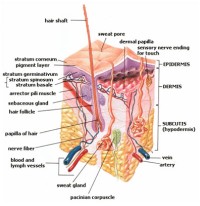
Skin diagramSkin Facts

Learn some fun skin facts for kids. The skin of both humans and other animals can be much more than just a physical line of defense.
Your skin performs important functions that allow you to live a normal life, you might not notice it happening but you can be sure your skin is doing its part to keep your body healthy. Read on and enjoy the following interesting facts about skin.


  • The colour of a humans skin is determined by the level of pigment melanin that the body produces. Those with small amounts of melanin have light skin while those with large amounts have dark skin
  • Skin is the human body’s largest organ (an organ is a group of tissues that work together to perform functions in your body, others include your brain, heart and lungs).
  • Your skin performs a range of different functions which include physically protecting your bones, muscles and internal organs, protecting your body from outside diseases, allowing you to feel and react to heat and cold and using blood to regulate your body heat.
  • The layers of mammal skin include the epidermis, dermis and subcutis.
  • The outer layer of your skin is the epidermis, it is found thickest on the palms of your hands and soles of your feet (around 1.5mm thick).
  • The subcutis (or hypodermis) is the deepest layer of your skin, as well as storing fat, it also contains blood vessels, hair follicle roots and nerves.
  • If skin is severely damaged then it may try to heal by forming scar tissue. Scar tissue is not the same as normal skin tissue, it often appears discolored and lacks sweat glands and hair.
  • The color of human skin depends on the amount of pigment melanin that the body produces. Small amounts of melanin result in light skin while large amounts result in dark skin.
  • Areas that experience repeated friction or pressure can form tough, thick skin known as a callus. Common examples of calluses can be seen on the hands of tennis players and the fingertips of guitarists.
  • A large amount of the dust in you home is actually dead skin.
  • All mammals have some hair on their skin, even if it isn’t easy for you to see.
  • Rhinoceros’s are protected by thick skin which can be between 1.5cm and 5cm deep.
  • Although polar bears have both white and transparent (see through) fur, their skin is actually black.
  • Amphibians such as frogs have unique skin. Rather than drinking water, frogs actually soak it into their body through their skin. They also use their skin to absorb around half the air they need.
  • Snakes have smooth, dry skin.
  • A number of different sea creatures, such as sea lice and barnacles, attach themselves to the skin of whales, making it their home.
  • Some fruits and vegetables are known to have ‘skins’, these include bananas, oranges, apples and potatoes.

Blood Facts

Blood cellsBlood Facts

Enjoy these blood facts while learning some interesting facts and information about blood type, cells, pressure, plasma, donation and more. Found in humans and most animals, blood is an incredibly important bodily fluid that transports oxygen and various nutrients to our body’s cells.

  •  Red blood cells carry oxygen around the body. They are created inside the bone marrow of your bones.
  • Blood makes up around 7% of the weight of a human body.
  • Blood contains red blood cells, white blood cells and platelets.
  • These blood cells float in a yellow liquid called blood plasma. Blood plasma is made up of 90% water and also contains various nutrients, electrolytes, gases, proteins, glucose and hormones.
  • Blood plasma can be separated from the cells by spinning blood in a device known as a centrifuge until the cells collect at the bottom of the tube.
  • Red blood cells have the important job of carrying oxygen around the body. They also contain a protein called hemoglobin. Hemoglobin contains iron which combines with oxygen to give hemoglobin and our blood, a red color.
  • Red blood cells develop in bone marrow and circulate in the body for around 120 days.
  • White blood cells are an important part of the body’s immune system. They defend against certain bacteria, viruses, cancer cells, infectious diseases and other unwanted materials.
  • Platelets help blood clot in order to limit bleeding when your skin is cut. Blood clots can occasionally have negative effects, if they form in blood vessels going to the brain they can cause a stroke while clotting in a blood vessel going to the heart can lead to a heart attack.
  • As well as delivering important substances to our cells, blood also helps take away unwanted waste products.
  • Grouping human blood types can be a difficult process and there are currently around 30 recognized blood types (or blood groups). You might be familiar with the more simplified “ABO” system which categorizes blood types under O, A, B and AB. Do you know which blood type you are?
  • Many generous humans around the world give blood donations every year. This blood is used in important blood transfusions or made into medication.
  • There are strict rules that limit the number of people who can volunteer blood donations. These include screening processes that test for diseases that could be transmitted by a blood transfusion as well as ensuring recovery time for the donor’s body to replace its own blood.
  • One of the principal signs of life for humans is blood pressure, this is the measure of pressure that circulating blood has on the walls of blood vessels. Blood pressure is usually taken from a person’s upper arm. Although averages vary from person to person, a general human being is known to have a normal blood pressure of around 112/64 mmHg. High blood pressure can increase the risk of a stroke or heart attack.

Human Heart Facts

The human heartHuman Heart Facts

Enjoy these fun heart facts for kids and learn some interesting new facts and information about how the amazing human heart works.


  • Your heart beats around 100000 times a day, 36500000 times a year and over a billion times if you live beyond 30


  • The heart is one of the most important organs in the human body, continuously pumping blood around our body through blood vessels.
  • Your heart is located in your chest and is well protected by your rib cage.
  • The study of the human heart and its various disorders is known as cardiology.
  • The heart is made up of four chambers, the left atrium, right atrium, left ventricle and right ventricle.
  • There are four valves in the human heart, they ensure that blood only goes one way, either in or out.
  • Blood that leaves the heart is carried through arteries. The main artery leaving the left ventricle is the aorta while the main artery leaving the right ventricle is the pulmonary artery.
  • Blood going towards the heart is carried through veins. Blood coming from the lungs to the left atrium is carried through the pulmonary veins while blood coming from the body to the right atrium is carried through the superior vena cava and inferior vena cava.
  • You might have felt your own heart beating, this is known as the cardiac cycle. When your heart contracts it makes the chambers smaller and pushes blood into the blood vessels. After your heart relaxes again the chambers get bigger and are filled with blood coming back into the heart.
  • Electricity going through your heart makes the muscle cells contract.
  • You might have watched television shows or movies where a patient in a hospital is attached to an electrocardiogram (ECG). You might recognize it as the machine with a line moving across a screen that occasionally spikes (or remains flat when a patient is dying). This machine can measure the electricity going through a patient’s heart. A doctor can use the information to know when a patient is having heart rhythm problems or even a heart attack.
  • Heart attacks cause scar tissue to form amongst normal heart tissue, this can lead to further heart problems or even heart failure.

Brain Facts

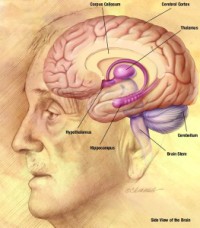
The human brainBrain Facts

Check out these fun brain facts for kids and learn some interesting facts and information that will help explain more about this amazing part of the human body.


  • The human brain is like a powerful computer that stores our memory and controls how we as humans think and react. It has evolved over time and features some incredibly intricate parts that scientists still struggle to understand.
  • The brain is the center of the human nervous system, controlling our thoughts, movements, memories and decisions.
  • With evolution, the human brain has become more and more complicated, many of its interesting properties are still not well understood by scientists.
  • The brain contains billions of nerve cells that send and receive information around the body.
  • The human brain is over three times as big as the brain of other mammals that are of similar body size.
  • Each side of the brain interacts largely with just one half of the body, but for reasons that are not yet fully understood, the interaction is with opposite sides, the right side of the brain interacts with the left side of the body, and vice versa.
  • The largest part of the human brain is called the cerebrum. Other important parts include corpus callosum, cerebral cortex, thalamus, cerebellum, hypothalamus, hippocampus and brain stem.
  • The human brain is protected by the skull (cranium), a protective casing made up of 22 bones that are joined together.
  • The brain of an adult human weighs around 3 pounds (1.5 kg). Although it makes up just 2% of the body's weight, it uses around 20% of its energy.
  • The brain is suspended in Cerebrospinal fluid, effectively floating in liquid that acts as both a cushion to physical impact and a barrier to infections.
  • Diseases of the brain include Alzheimer’s disease, Parkinson's disease and multiple sclerosis. Diseases such as these can limit the normal function of the human brain.
  • Most strokes result from a blood clot in the brain that blocks the local blood supply, this causes the damage or destruction of nearby brain tissue and a wide range of stroke symptoms.